December 11, 2025
To: Congresswoman Lateefah Simon, Skyelar Montgonmery Staff Member, Joshua Mason Archivist NARA, Mary Fortier Secretary of State legal Counsel. Connecticut Office of Legal Research, Mel Smith Connecticut State Library
I am writing to address a critical issue surrounding the Connecticut records housed in the unratified box at the National Archives and Records Administration that are currently relied upon to support the conclusion that the Connecticut General Assembly “did not ratify” the Titles of Nobility Amendment proposed by Congress in May 1810. ‘
After extensive research into the primary documents, it has become clear that the records underlying this conclusion are legally invalid, constitutionally irrelevant, and cannot be used for determining Connecticut’s Article V action.
The central problem is that the Connecticut House Journal entry and the Committee Report purporting to show a negative action contain false and non-genuine attestation signatures attributed to Charles Denison and Theodore Dwight.
These signatures do not match verified exemplars, fail basic authentication standards, and exhibit characteristics inconsistent with period handwriting. Under the Federal Rules of Evidence and the Connecticut Code of Evidence, a public document must be authenticated by proving the genuineness of its signatures and the integrity of its creation.
Because these documents contain forged attestation signatures, they cannot be treated as authentic public records, nor can they serve as a basis for any downstream government conclusion.
False attestation breaks the chain of custody and destroys the evidentiary foundation upon which the document rests. Under the evidentiary doctrine falsus in uno, falsus in omnibus, a single proven falsity renders the entire document unreliable, and every subsequent record that relies upon it becomes equally tainted.
Even if these journal entries were genuine, Supreme Court jurisprudence makes clear that internal legislative materials such as journals and committee reports have no legal force in determining a state’s action under Article V. The Court’s rulings in Hawke v. Smith and Leser v. Garnett hold that only the legislature’s vote, authenticated by the proper executive authority and transmitted to the United States, constitutes a valid act of ratification or rejection.
https://usge13.com/files/777.png Governor John Cotton Smith executive transmittal stating “ADOPTED”
Internal notes, editorial comments, or committee findings cannot contradict, amend, or override an authenticated certification. Article V establishes a federal function carried out by each state legislature, and that function is complete once the executive transmits the authenticated certificate.
Connecticut’s authenticated action was transmitted by Governor John Cotton Smith on June 2, 1813, and received by the Department of State no later than early June of that year. That certificate satisfies the requirements of Article V and 1 U.S.C. § 106b, and it remains the only valid legal evidence of Connecticut’s action.
The later-appearing journal entries and committee remarks that NARA currently relies upon were never transmitted as part of Connecticut’s official Article V action, were never authenticated by the proper state officers, and do not meet the statutory requirements of 1 U.S.C. § 106b.
Their lack of authentication alone disqualifies them from consideration, but the presence of forged signatures elevates the problem to one of legal invalidity. Federal criminal statutes reinforce this conclusion. Under 18 U.S.C. § 1001, it is unlawful for any person to knowingly use or rely upon false or fraudulent official documents in matters within federal jurisdiction.
Under 18 U.S.C. § 1018, any official writing containing false statements or issued under false pretenses is void. Under 18 U.S.C. § 1519, any altered, falsified, or fabricated government record is treated as invalid from its inception.
Thus, any Connecticut records containing forged signatures, or any federal summaries derived from such records, are void ab initio and cannot be used by the National Archives or any federal agency to determine a constitutionally significant fact.
Connecticut law points to the same conclusion. State statutes prohibit false statements, tampering with public records, and the fabrication of evidence. Documents that violate these provisions cannot be treated as lawful state records for any governmental purpose. Because the journal entries and committee report that claim Connecticut “did not ratify” are neither genuine nor legally authenticated, they cannot be relied upon by state or federal officials, and they hold no evidentiary value in determining Connecticut’s constitutional action.
Taken together, the forged signatures, the lack of authentication, the violation of federal and state statutes, and the controlling authority of Article V and the Supreme Court make clear that the Connecticut records currently used by NARA to support a “do not ratify” conclusion are not valid records.
They are constitutionally irrelevant, legally unreliable, and incapable of overturning or contradicting Governor Smith’s genuine and properly authenticated certification of June 2, 1813. That certification remains the only lawful evidence of Connecticut’s action on the Titles of Nobility Amendment, and it demonstrates that Connecticut ratified the amendment.
Accordingly, the National Archives cannot lawfully rely on the altered or forged materials currently in its files for any determination related to the amendment’s status.
I respectfully request that these issues be reviewed in light of the laws and evidence presented above, and that the authentic certification of 1813 be recognized as the controlling legal document.
Under the present circumstances, the executive branch records constitute the controlling and authoritative evidence of Connecticut’s constitutional action regarding the Titles of Nobility Amendment.
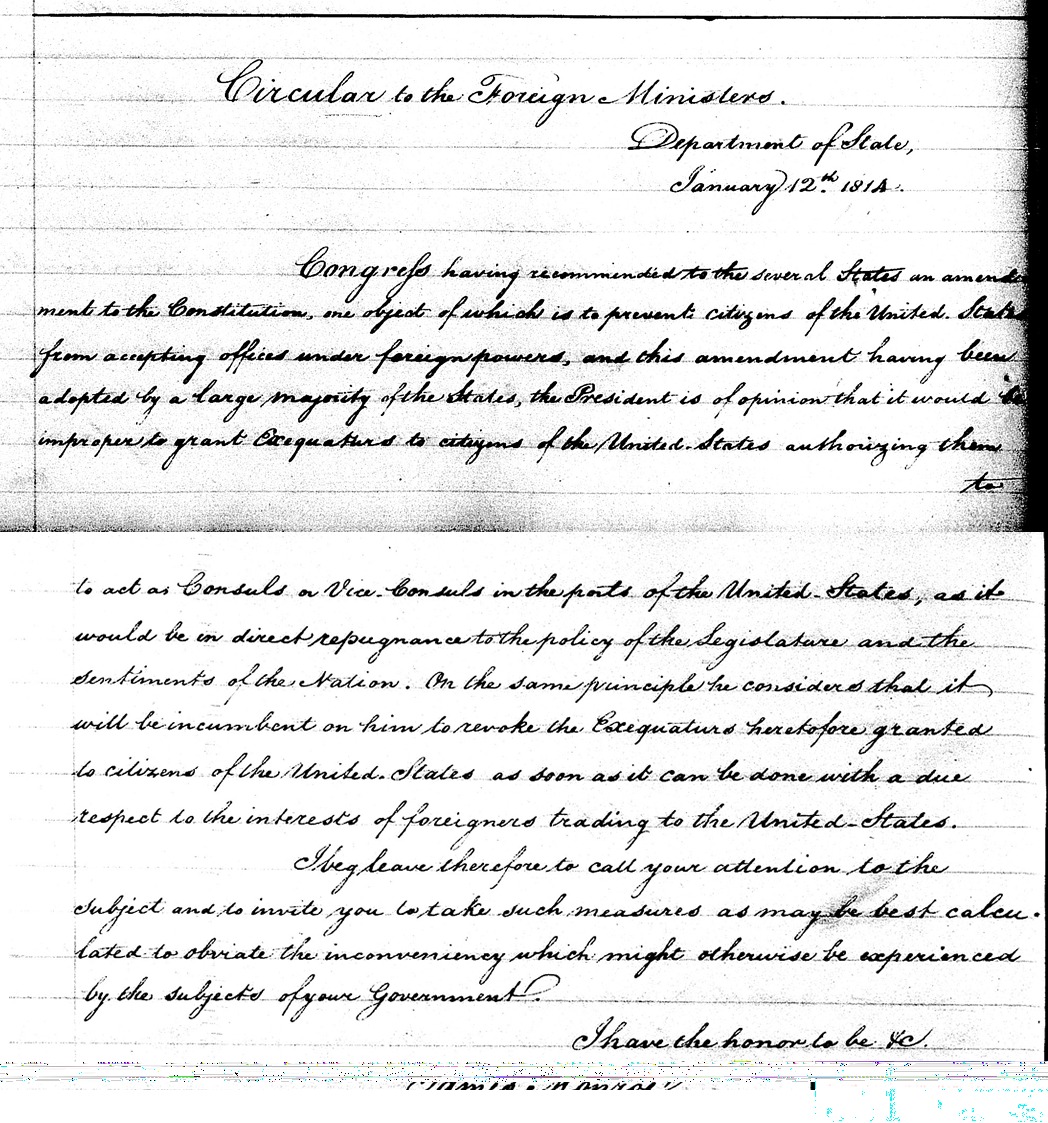
https://usge13.com/files/3.png President Madison and Secretary of State Monroe Circular “ADOPTED”
The governing structure of Article V makes clear that the only legally operative act of a state legislature is the vote as authenticated and transmitted by the state’s executive authority to the United States. Once such a certification is received by the federal executive branch, that certificate becomes the binding and conclusive record of the state’s action.
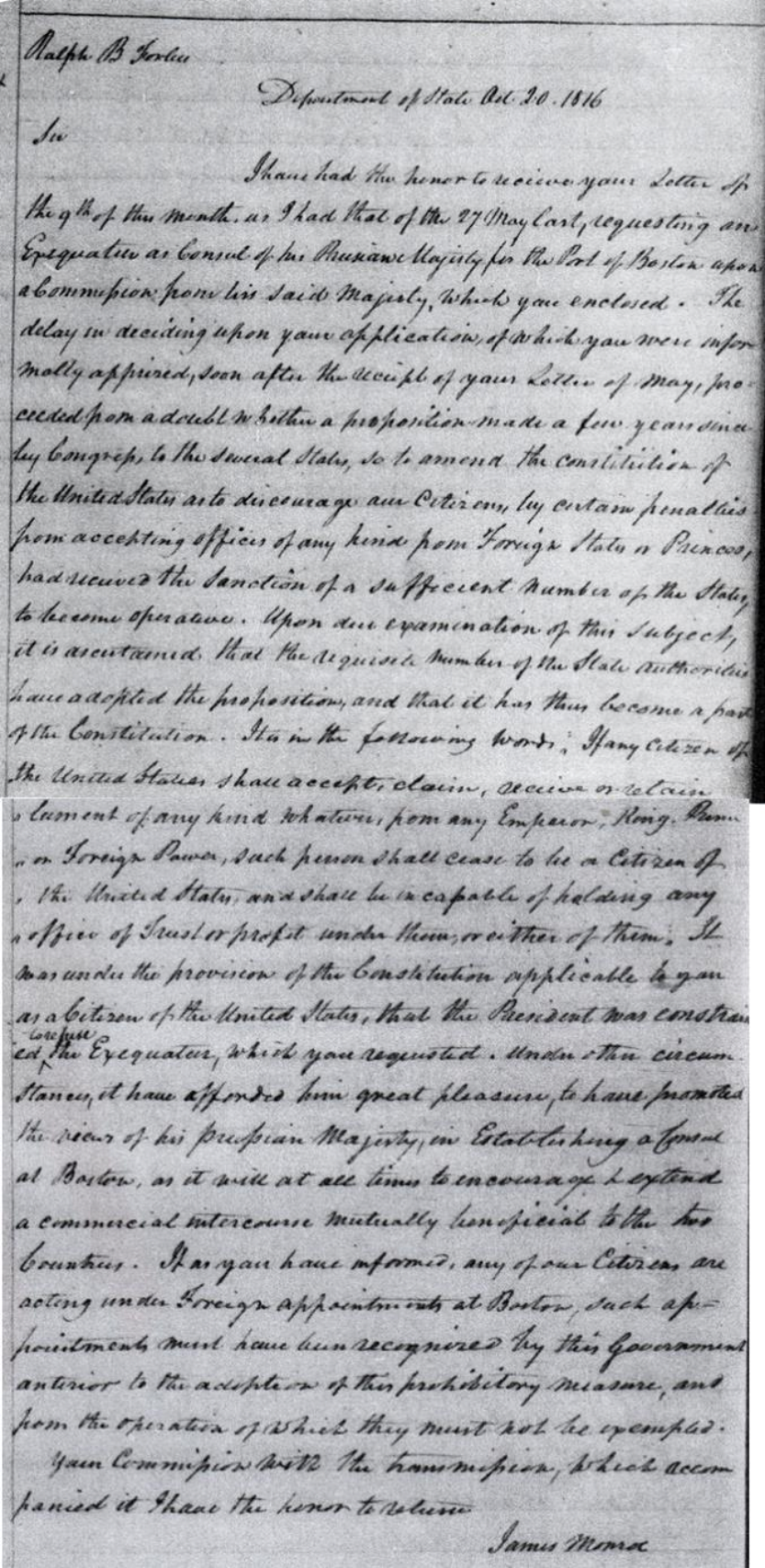
https://usge13.com/files/1816.png President Madison and Secretary of State Forbes letter “Upon due examination of this subject, it has been ascertained that the requisite number of state authorities have adopted the proposition and that it has thus become a part of the Constitution”.
Internal journals, committee notes, or later annotations within the state hold no constitutional authority to revise or contradict it.
This principle has been reinforced repeatedly by the Supreme Court. Decisions such as Hawke v. Smith and Leser v. Garnett make plain that amendment ratification is a federal function completed at the moment the authenticated certificate is transmitted to the federal government.
The internal papers of a state legislature, whether they be journals, committee reports, or editorial observations, cannot alter or diminish an executive certification. These internal materials are not part of the constitutional process, and they carry no legal weight under Article V. Only the authenticated certificate transmitted by the governor or the proper constitutional officer holds authority.
Given the present situation, where the Connecticut House Journal entry and the Committee Report relied upon to suggest non-ratification contain forged signatures, lack proper authentication, and were never transmitted to the federal government, the supremacy of the executive branch record becomes even clearer.
A document that contains false attestation signatures cannot serve as a lawful representation of legislative action. Its authenticity fails at the threshold, and no legal system, federal or state, permits a forged instrument to displace an authenticated executive certificate. When a document is false in its attestation, the entire record becomes void, and any downstream government conclusion resting upon it collapses alongside it.
Federal law reinforces this outcome. The statute governing federal recognition of state actions on constitutional amendments, 1 U.S.C. § 106b, requires that only properly authenticated state certifications may be used to determine the validity of a constitutional amendment.
Documents that were never transmitted to the federal government or lack genuine authentication simply do not qualify. Under this statute, the only Connecticut record that satisfies the legal requirements is the June 2, 1813, certification executed by Governor John Cotton Smith and acknowledged by the Department of State. That certificate remains the controlling legal document.
Federal criminal statutes also make it unlawful for any agency to use or rely upon falsified or altered public records. Under 18 U.S.C. §§ 1001, 1018, and 1519, any record containing forged signatures or fabricated content is treated as invalid from its inception. Such a record cannot be used to establish a constitutional fact, nor can it legally modify or contradict a genuine executive certification. When internal state records are contaminated by forgery, the federal government must disregard them entirely and rely exclusively on authenticated executive materials.
For these reasons, the executive branch record transmitted by Connecticut in June of 1813 is not merely one source of information; it is the sole controlling legal evidence of Connecticut’s action on the Titles of Nobility Amendment. Under Article V, Supreme Court doctrine, federal authentication statutes, evidentiary rules, and criminal law, nothing within Connecticut’s internal journals, particularly records compromised by forged signatures, can supersede or override the authentic certification already in federal custody. The executive record remains the binding authority, and it stands unrefuted.
https://www.youtube.com/watch?v=PvTQGsAde4Y Video showing and explaining non authentic signatures
Sincerely,
Stanley Evans